
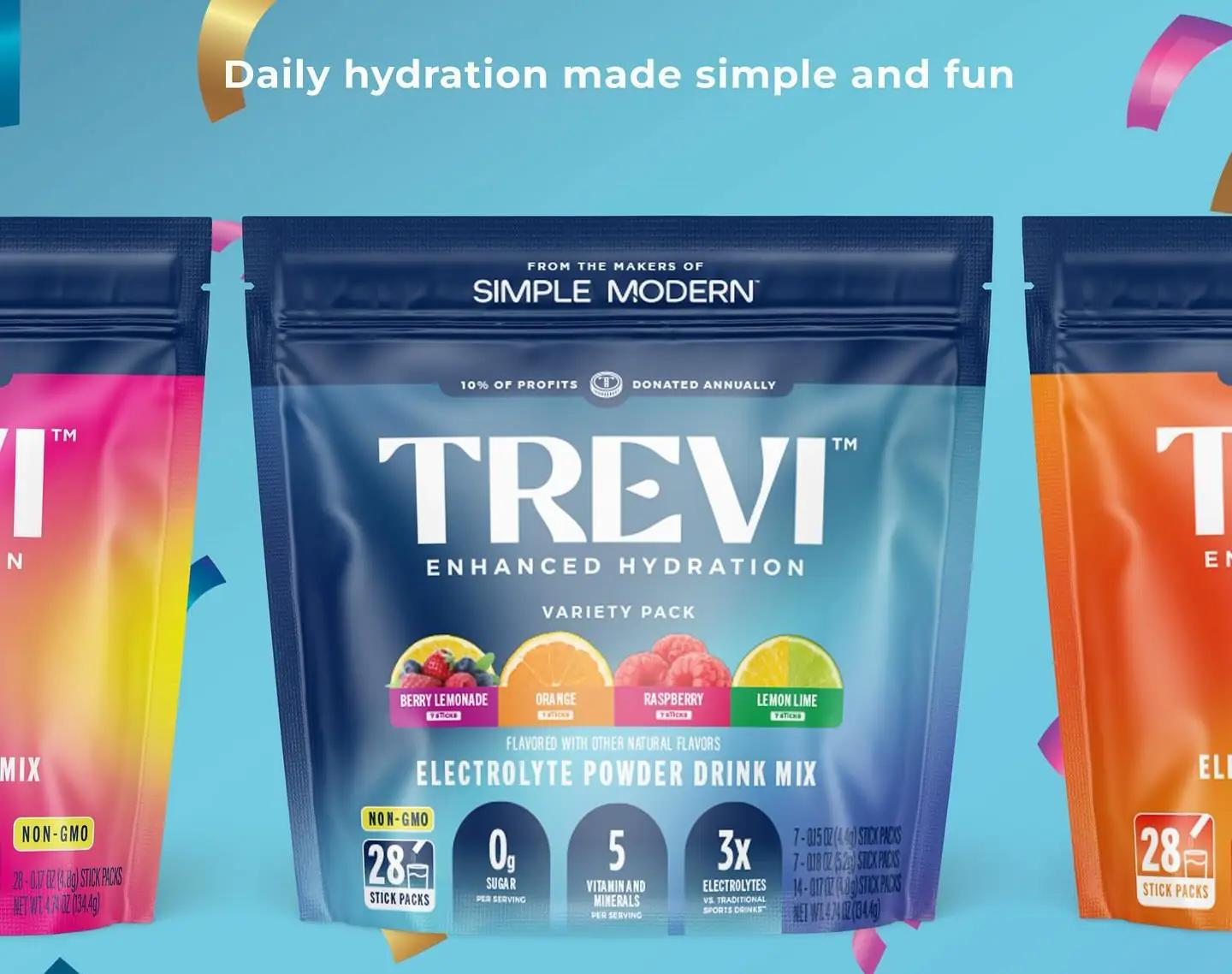
 The electrolyte supplement market has exploded in recent years, growing from niche sports nutrition products to mainstream wellness essentials. What began as specialized formulas for elite athletes has evolved into an estimated $580 million industry in 2024, projected to reach $665.8 million by 2029. Within this competitive landscape, a fascinating market disruption is taking place: Simple Modern, a company known for its stylish insulated drinkware, has strategically entered the hydration supplement space with its new brand, Trevi.
I find Trevi's market entry particularly compelling. This isn't just another electrolyte brand—it represents a thoughtful expansion strategy that leverages existing customer relationships, addresses genuine consumer pain points, and reframes the entire hydration supplement category. In this comprehensive analysis, we'll examine how Trevi has positioned itself in a crowded market and what eCommerce businesses can learn from their approach.
The Genesis Story: From Drinkware to Drink Mix

Simple Modern's journey to launching Trevi wasn't rushed. According to Corbin Wallace, CEO of Trevi (and formerly Chief Growth Officer at Simple Modern), the team initially considered entering the hydration supplement market in 2023 but decided to delay the launch because Simple Modern was experiencing its fastest growth year. After revisiting the concept in mid-2024, they determined the timing was right to enter the rapidly expanding hydration enhancement market.
This careful timing demonstrates strategic patience—a quality often lacking in today's hyper-competitive CPG environment where brands race to market. By waiting for the optimal moment, Simple Modern ensured they had the operational bandwidth to support a successful product launch while continuing to grow their core business.
The connection between drinkware and drink supplements is obvious in retrospect, but Simple Modern's execution reveals careful planning. With over 50 million cups sold, the company had built an enormous customer base of people actively engaged in daily hydration. As Wallace explained, "We believe that there is a trust that we've built with the customer segment that uses Simple Modern that we're able to create high quality products that bring value to their life in an affordable manner, and we think that they're going to get that same experience with Trevi."
This trust transfer concept is powerful. Rather than starting from zero brand recognition, Trevi launched with an implied endorsement from a brand millions of consumers already know and trust for hydration products.
Identifying the "Everyday Hydration" White Space
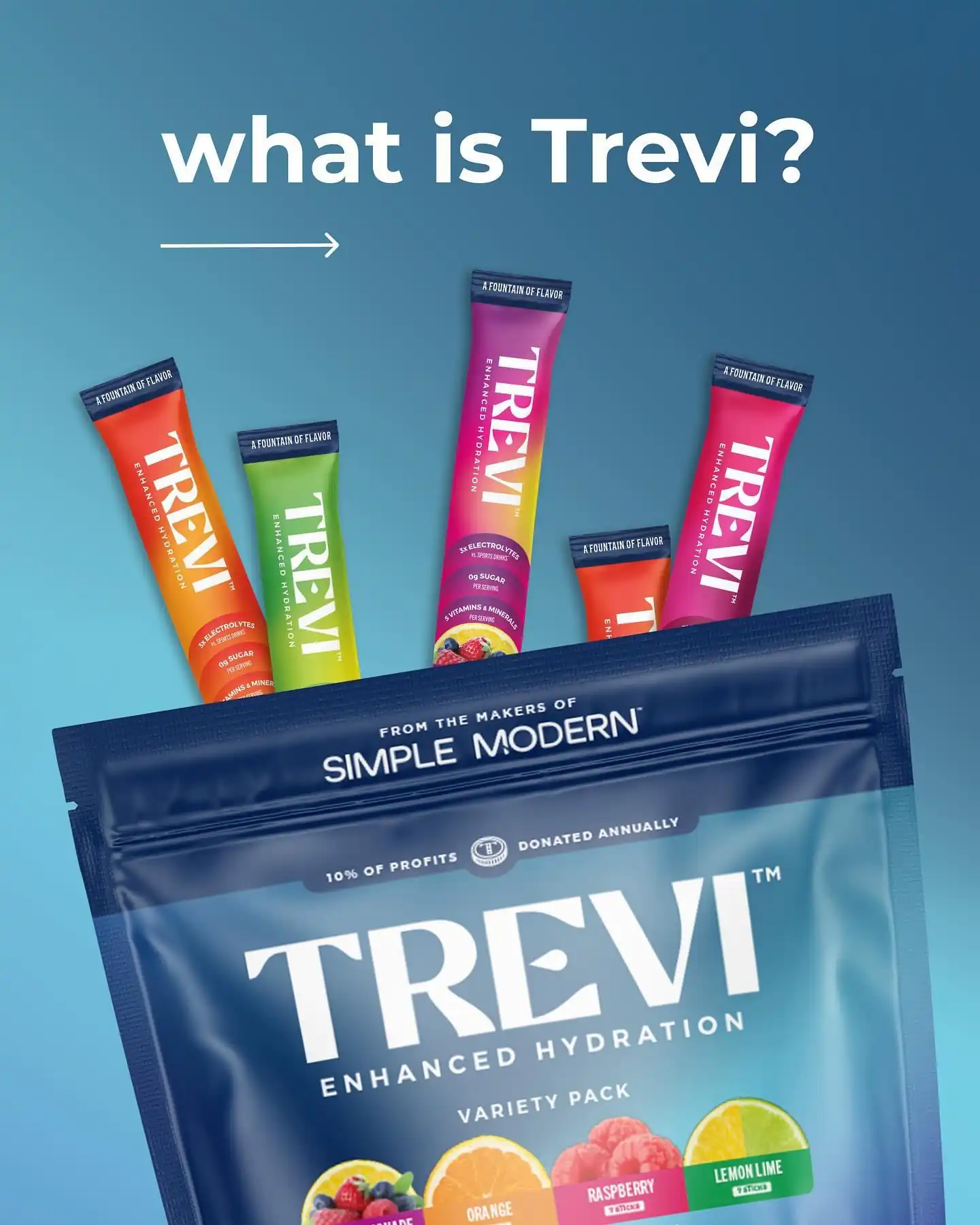 Trevi's most significant strategic insight was identifying an underserved segment in the electrolyte market. Let's analyze the competitive landscape they faced:
Performance-Focused Brands:
- LMNT: Ultra-high sodium content (~1000mg per serving) targeting keto dieters and serious athletes
- DripDrop: Medical-grade oral rehydration solution used by military and first responders
- Liquid I.V.: "Hydration multiplier" using Cellular Transport Technology to accelerate water absorption
Convenience-Focused Brands:
- Nuun: Effervescent tablets popular with runners and endurance athletes
- Propel: Mainstream electrolyte water with fitness positioning
- Gatorade Endurance: Sports performance-focused powder for intense activity
What Trevi recognized was a significant gap between these specialized performance products and plain water enhancers (like MiO or Crystal Light). The vast majority of Americans aren't extreme athletes or training for marathons—they're everyday people who simply don't drink enough water and find plain water boring.
As Wallace articulated, "We created Trevi so that staying hydrated doesn't have to be boring." This positioning statement perfectly captures the white space Trevi aimed to fill: making hydration enjoyable for regular people during ordinary activities, not just during or after workouts.
This insight expanded the total addressable market significantly. Rather than competing for a share of existing electrolyte users (primarily active individuals), Trevi could target the much larger segment of people who struggle with daily hydration but don't identify as athletes or fitness enthusiasts.
Product Development: Engineering the Perfect Everyday Formula
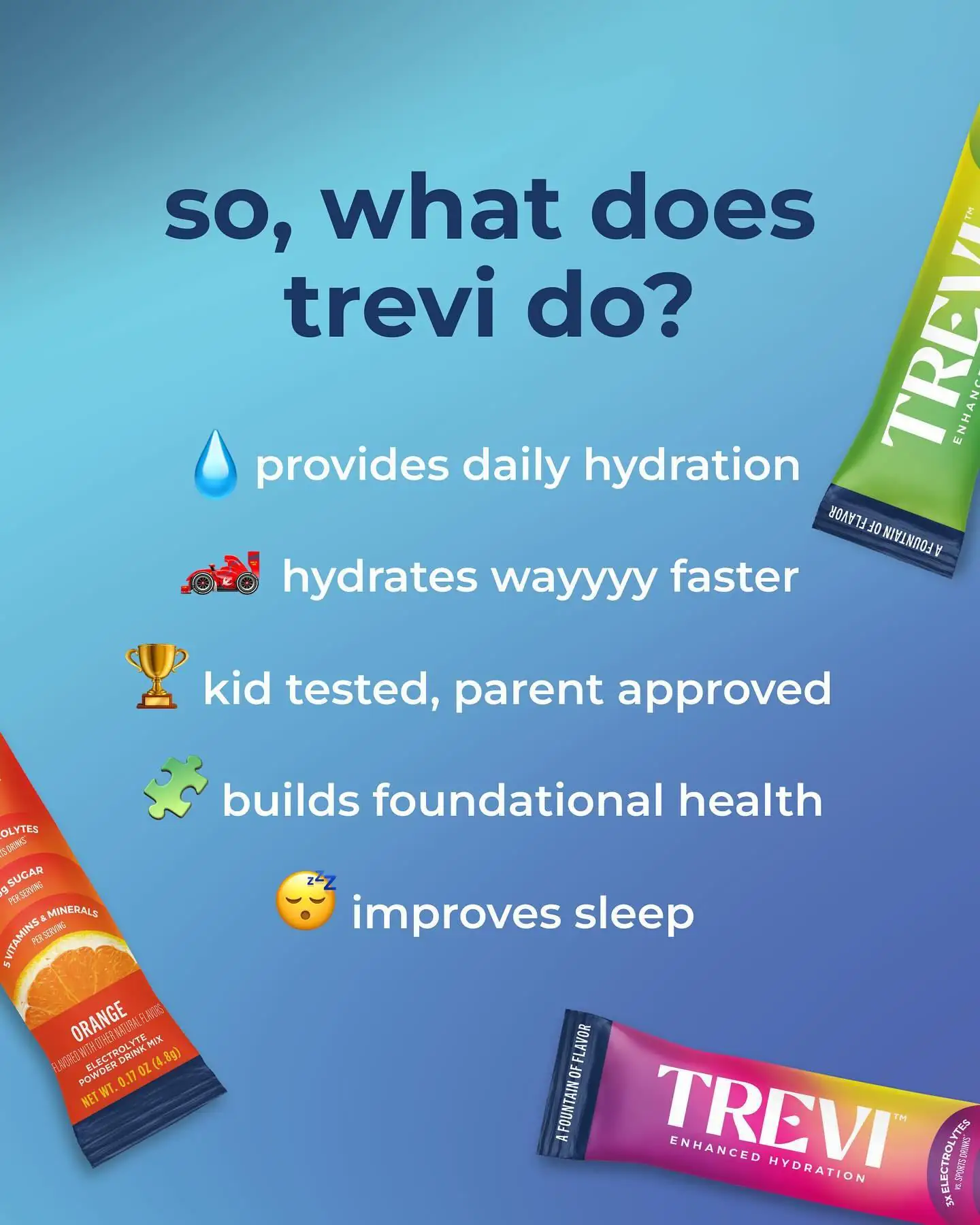 Trevi's product development process reveals sophisticated market understanding. The team needed to create a formula that balanced several competing priorities:
- Electrolyte content: Sufficient for noticeable benefits without excess sodium
- Taste profile: Enjoyable enough for daily consumption without sugar
- Clean ingredients: Meeting modern consumer expectations for wellness products
- Dissolution properties: Quick-mixing without clumping for convenience
- Price point: Affordable enough for daily use while maintaining premium positioning
The resulting formula contains several key differentiators:
- Electrolyte blend: Sodium (from Pink Himalayan Salt), potassium (from Potassium Phosphate and Potassium Citrate), magnesium (from Magnesium Citrate), and calcium (from Calcium Citrate)—claimed to be three times the amount in traditional sports drinks but lower sodium than specialized athletic mixes like LMNT
- Zero sugar formula: Unlike Liquid I.V. (~11g sugar) or DripDrop (~7g sugar), Trevi contains no sugar, using a blend of sucralose and stevia leaf extract for sweetness
- Added vitamins: Five essential vitamins and minerals including Vitamin C and zinc for additional wellness benefits
- Natural colorants: Beet juice powder and fruit/vegetable juice for color rather than artificial dyes
- Clean label credentials: Non-GMO, vegan, allergen-free, and no artificial preservatives
The product is packaged in single-serve powder packets that mix with 16-32 ounces of water, allowing users to customize flavor intensity. This variability is significant—it allows consumers to adapt the product to their preferences, whether in a small glass or a large water bottle.
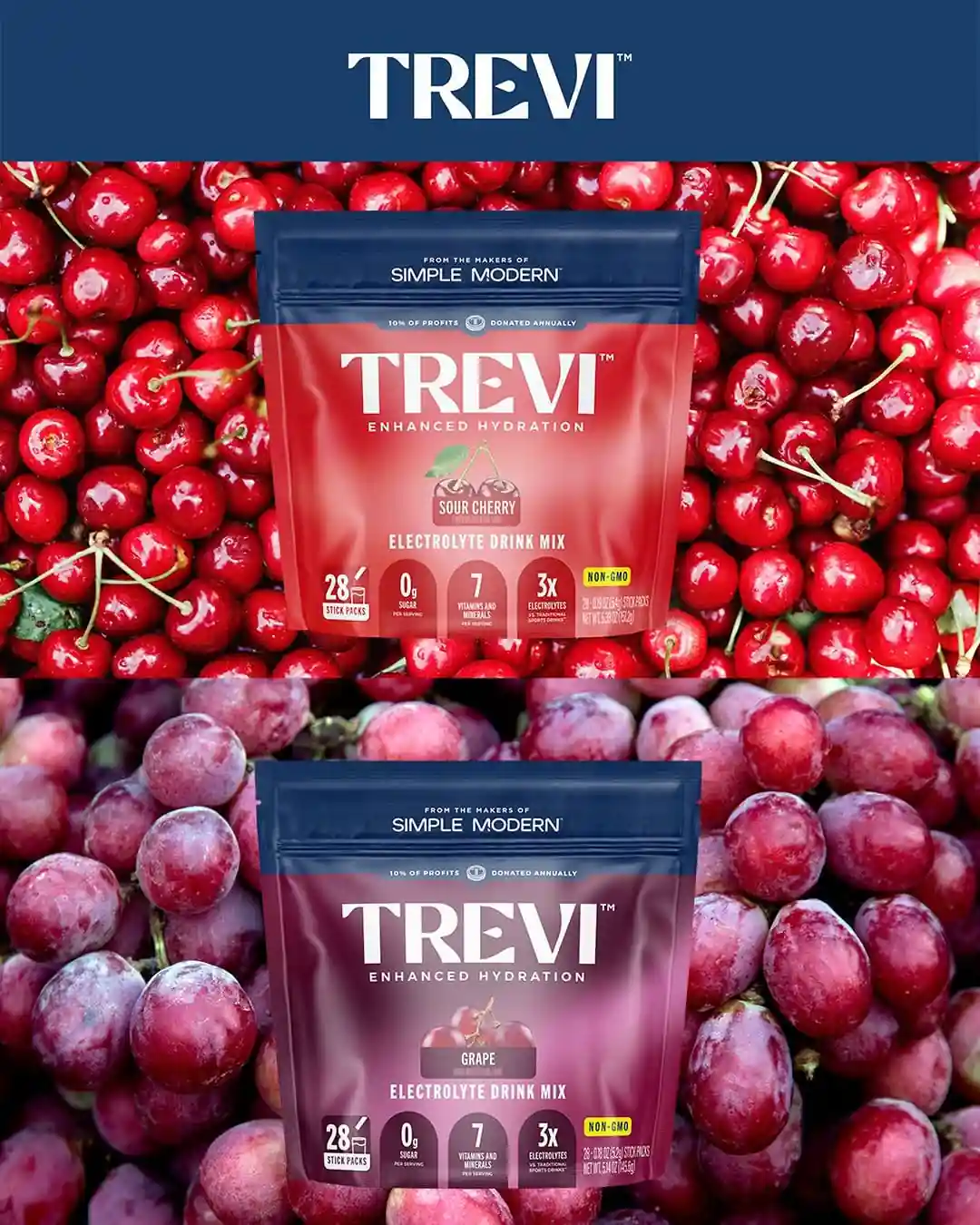
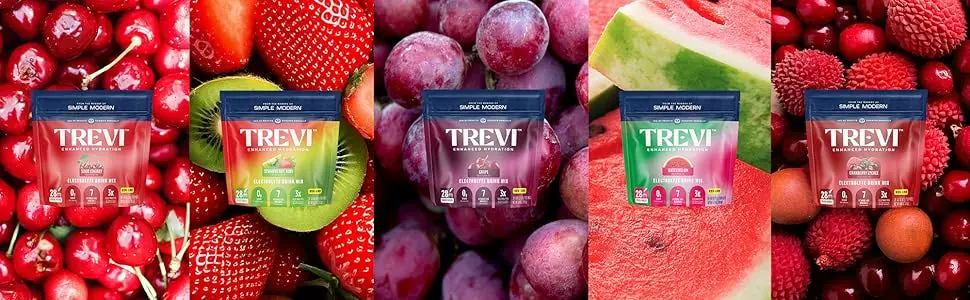
Trevi launched with four classic flavors (Berry Lemonade, Lemon Lime, Orange, and Raspberry) before quickly expanding to eight options, including Watermelon, Strawberry Kiwi, Grape, and Cranberry Lychee. This flavor variety creates choice and encourages experimentation, important factors for subscription retention.
Go-to-Market Strategy: Digital-First Dominance
 Trevi's launch strategy demonstrates textbook digital-first CPG execution with three distinct phases:
Phase 1: Direct-to-Consumer Focus (December 2024)
Trevi launched exclusively through its own website (drinktrevi.com) with several strategic elements:
- $1 sampling program: Allowing new customers to try a small pack for just $1, dramatically lowering the barrier to trial
- Aggressive subscription incentives: 25% discount plus free shipping for subscribers
- Loyalty rewards: Free 40oz Simple Modern Trek tumbler ($29.99 value) after the third subscription order
- Launch discount: 30% off initial purchases with code TREVILAUNCH30
- Variety packs and single-flavor options: Catering to both explorers and those with established preferences
This DTC-first approach allowed Trevi to control the customer experience, gather first-party data, test messaging efficacy, and build high-margin subscriber relationships. The website features authentic customer testimonials that often explicitly compare Trevi favorably to competitors: "I used to buy Liquid IV now I'll be drinking Trevi" and "same amount of electrolytes [as LMNT], 10× the flavor, at a more reasonable price."
The digital strategy included a strong emphasis on community building through social media, particularly TikTok. The hashtag #TreviHydration has garnered millions of views, with some discovery pages showing over 83 million related posts. This organic virality suggests Trevi's messaging is resonating with target consumers.
Phase 2: Marketplace Expansion (Early 2025)
Following initial DTC traction, Trevi quickly expanded to major eCommerce marketplaces:
- Amazon: Building a strong presence with over 300-400 reviews and an impressive 4.6/5-star average rating
- TikTok Shop: Directly monetizing social content with in-app purchasing
- Walmart.com: Expanding reach via America's largest retailer
This marketplace strategy extends reach while benefiting from the social proof already established through DTC channels. On Amazon, Trevi has achieved ranking in the top 25 of Sports Nutrition Electrolyte Replacement Drinks category—impressive for a newcomer in a competitive space dominated by established brands.
Phase 3: Omnichannel Retail (Planned)
According to press releases, Trevi plans to enter physical retail channels in 2025, following Simple Modern's proven distribution playbook:
- Walmart brick-and-mortar: Leveraging existing relationships through Simple Modern
- Additional retailers: Likely targeting stores where Simple Modern already has presence
This phased approach—DTC testing, then marketplace expansion, then physical retail—mimics Simple Modern's successful growth model. It allows for product refinement based on customer feedback before making significant investments in retail distribution, where margins are typically lower and brand control more limited.
Pricing Strategy: The Strategic Middle Path
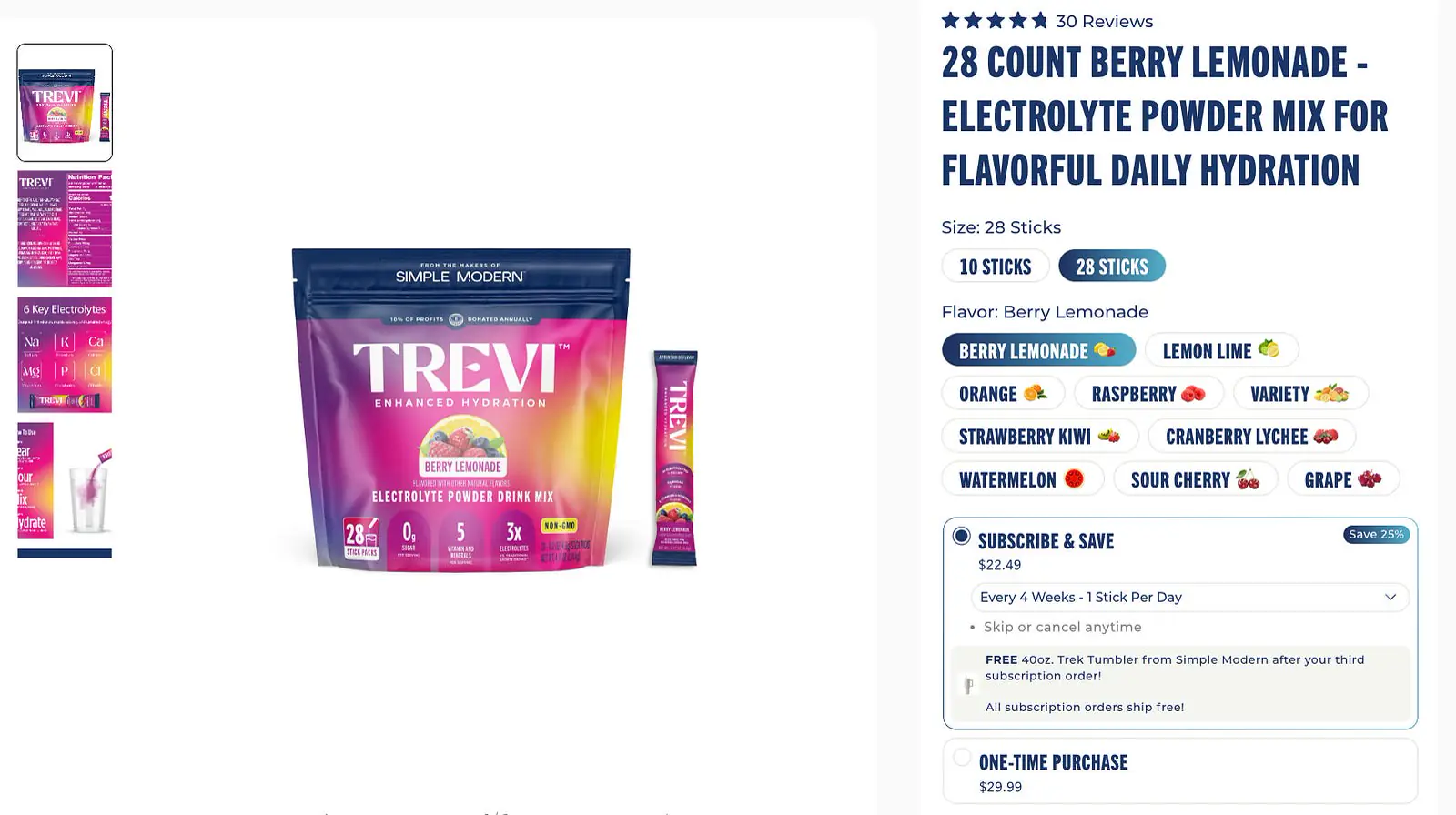
Trevi's pricing strategy reveals careful positioning within the premium electrolyte market:
- Standard pricing: $29.99 for 28 servings (~$1.07 per serving)
- Subscription pricing: $22.50 for 28 servings with 25% discount (~$0.80 per serving)
- Trial size: $11.99 for 10 servings (~$1.20 per serving)
This pricing structure accomplishes several goals:
- Competitive positioning: More affordable than category leaders Liquid I.V. and LMNT (both ~$1.50/serving at retail), yet premium compared to basic options like Nuun (~$0.70/serving)
- Value perception: "3× electrolytes" and added vitamins justify premium over basic hydration enhancers
- Subscription incentive: The 25% discount creates a meaningful reason to subscribe
- Trial accessibility: The $11.99 10-pack and $1 sample offer reduce risk for first-time buyers
The pricing architecture strikes a delicate balance—premium enough to communicate quality and support healthy margins, yet accessible enough for daily use. Customer reviews specifically mention the value: "same electrolytes [as LMNT], 10× the flavor, at a more reasonable price."
Interestingly, Trevi chose a 28-count package rather than the more common 30-day supply. This 4-week quantity might subtly encourage monthly repurchases while keeping the pack price just under the psychological $30 threshold.
Brand Identity: Values-Driven Positioning
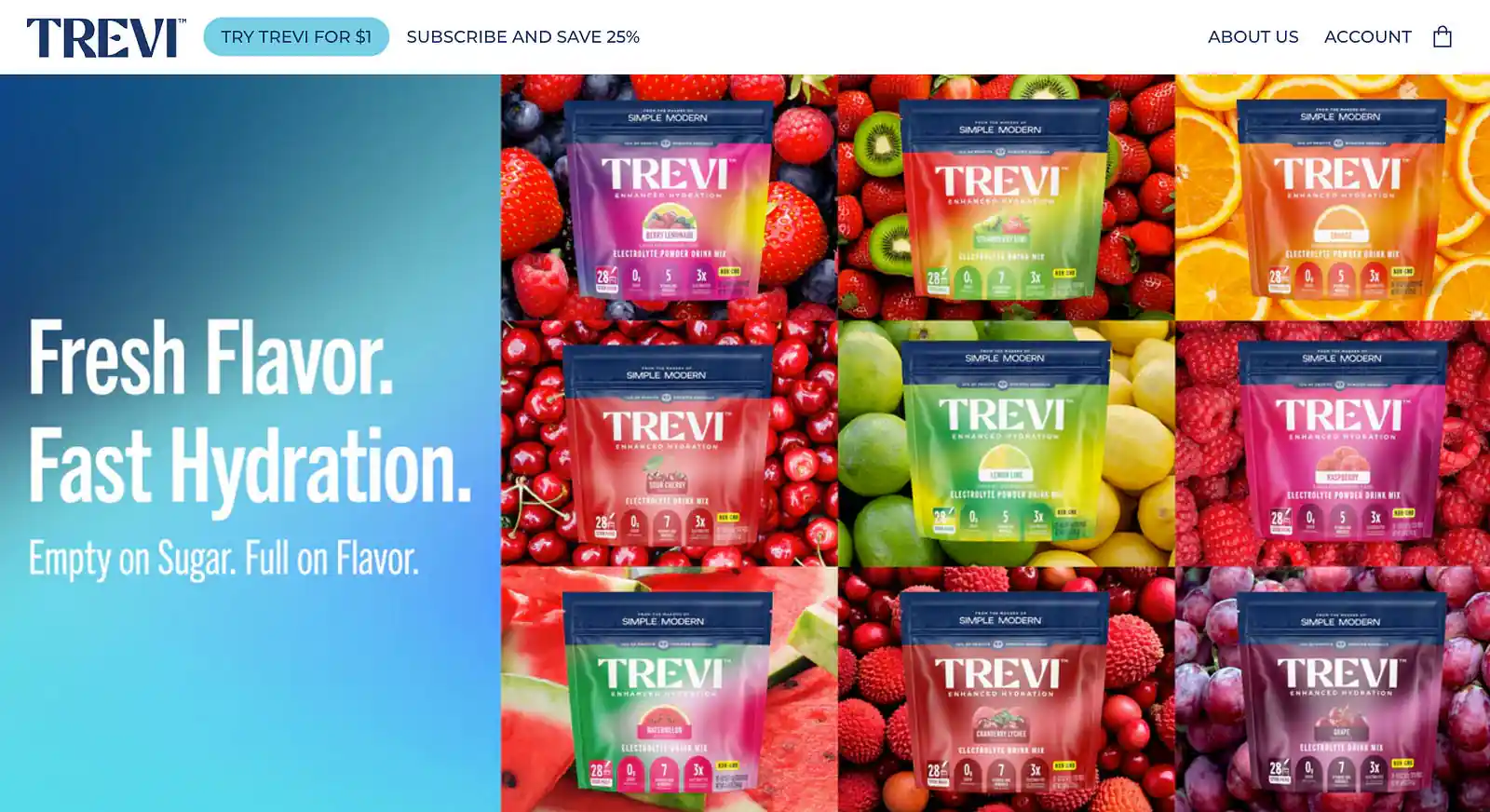
Trevi's brand identity extends beyond functional benefits to create emotional connections with consumers:
Name and Inspiration
The brand name "Trevi" evokes Rome's famous Trevi Fountain, symbolizing water, wishes, and generosity. This isn't merely aesthetic—it informs the brand's core identity:
- "A Fountain of Flavor" tagline: Connecting the fountain metaphor to product experience
- Charitable commitment: 10% of profits donated annually to charity, mirroring how coins tossed in the Trevi Fountain are collected for those in need
- Visual identity: Clean yet vibrant aesthetic with bold gradients and fruit imagery
Brand Voice and Messaging
Trevi's marketing consistently emphasizes making hydration enjoyable rather than medicinal:
- "Goodbye boring, hello hydration" slogan addresses the fundamental reason many people don't stay properly hydrated
- "Hydration should never be boring" reinforces the enjoyment factor
- "Every Sip Counts" connects product use to the charitable mission
This messaging directly contrasts with competitors focused on performance metrics or medical benefits. While LMNT emphasizes electrolyte ratios and Liquid I.V. touts its Cellular Transport Technology, Trevi simply promises to make drinking water more enjoyable.
Visual Branding
Trevi's packaging design communicates several key attributes:
- Bold flavor-coded colors: Each flavor has its own vibrant gradient
- Simple Modern co-branding: "From the makers of Simple Modern" creates instant trust
- Clear benefit icons: "0g Sugar," "5 Vitamins," "3× Electrolytes," "Non-GMO" prominently displayed
- Quality signifiers: "Pink Himalayan Salt" and "Natural Flavors" highlight premium ingredients
The overall aesthetic is premium yet approachable—more sophisticated than mainstream sports drinks but less clinical than medical-grade hydration solutions.
Cross-Brand Synergy: The Simple Modern Advantage
Perhaps Trevi's most significant competitive advantage comes from its relationship with Simple Modern. This synergy creates multiple strategic benefits:
Customer Acquisition Leverage
- Built-in audience: Access to millions of existing Simple Modern customers
- Email marketing synergy: Ability to cross-promote Trevi to the Simple Modern database
- Bundling opportunities: Joint promotions like the free tumbler after subscription milestone
Brand Trust Transfer
Launching Trevi as "From the makers of Simple Modern" provides several benefits:
- Immediate credibility: Consumers already trust Simple Modern for quality
- Quality expectations: Simple Modern's reputation for premium products extends to Trevi
- Reduced consumer risk: Familiar brand connection lowers perceived risk of trying a new product
Product Experience Integration
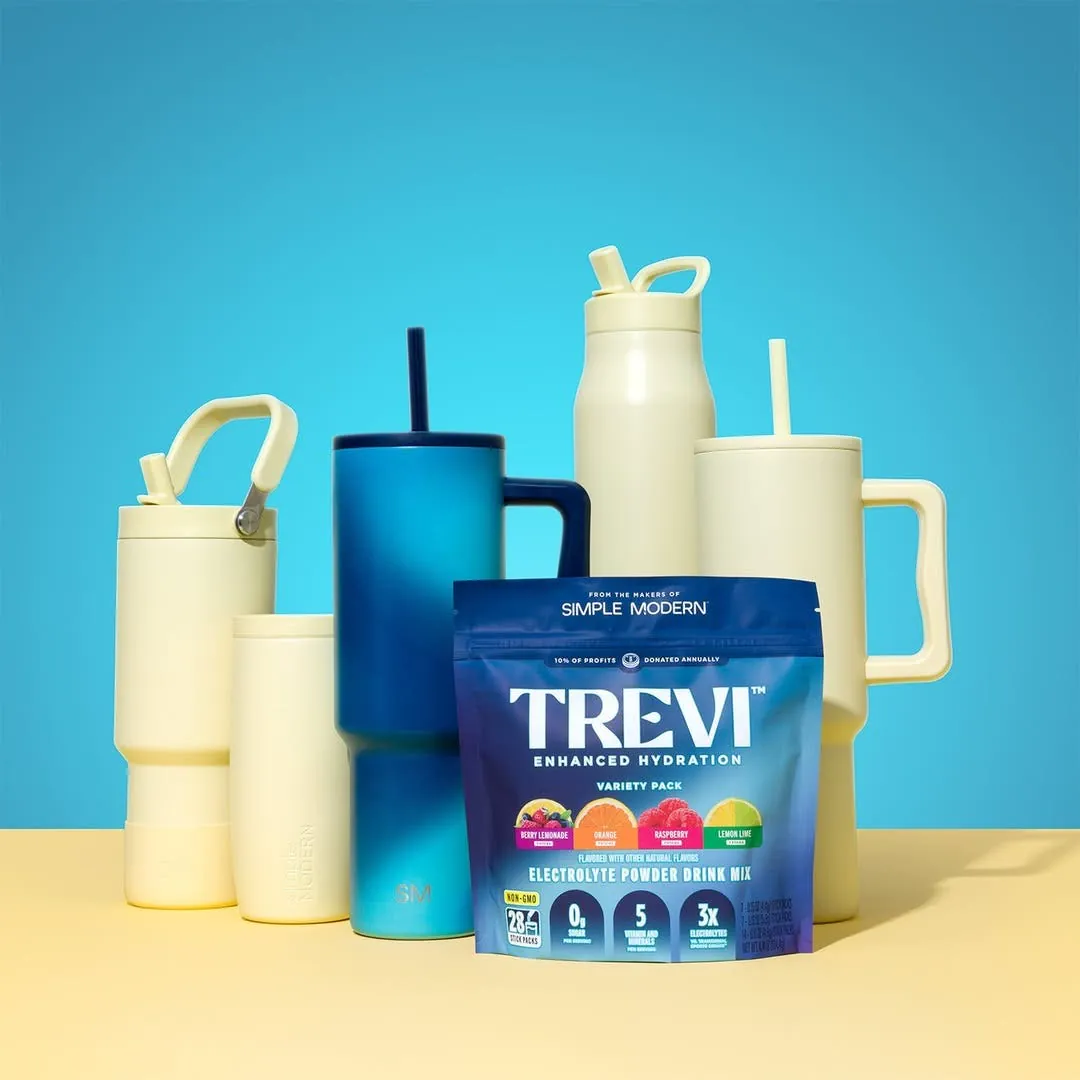
The natural pairing of Trevi packets with Simple Modern drinkware creates a complete hydration system:
- Usage visualization: Marketing shows Trevi being mixed in Simple Modern bottles
- Complementary function: Insulated bottles keep Trevi-enhanced water cold longer
- Lifestyle integration: The pairing becomes part of daily hydration routine
Operational Efficiencies
Beyond marketing, the Simple Modern connection likely provides operational advantages:
- Shared fulfillment infrastructure: Leveraging existing logistics networks
- Combined purchasing power: Better vendor terms for packaging and ingredients
- Retail relationship leverage: Easier conversations with buyers who already carry Simple Modern
This cross-brand synergy creates a moat that standalone hydration brands struggle to replicate. While competitors must acquire each customer independently, Trevi can tap into an existing base of consumers already committed to better hydration practices.
Social Proof Strategy: Building Credibility Through Community
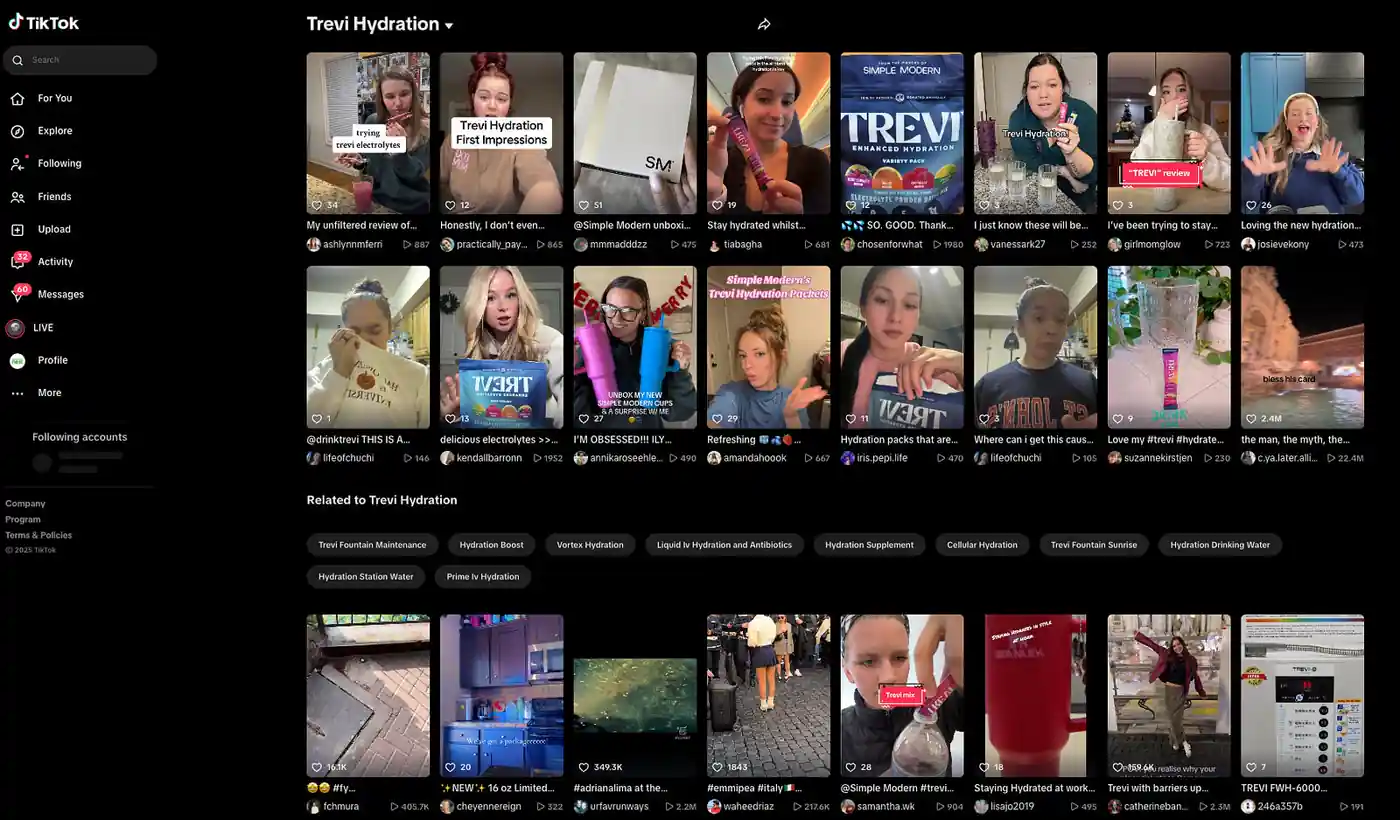
Trevi has rapidly built credibility through strategic social media and community engagement:
TikTok Dominance
The brand has achieved remarkable traction on TikTok, with:
- 83.4 million posts related to Trevi Hydration according to some TikTok discovery pages
- Viral unboxing videos showing Trevi's colorful packaging and mixing process
- "$1 sample" promotion gaining traction through social sharing
Influencer Partnerships
Rather than focusing exclusively on fitness influencers (as competitors often do), Trevi has engaged with:
- Lifestyle content creators demonstrating Trevi in everyday scenarios
- "Mom" influencers showing how Trevi helps them stay hydrated during busy days
- Micro-influencers creating authentic content around their daily hydration routines
User-Generated Content Amplification
Trevi actively encourages and shares user content:
- Giveaway contests for those who "stay engaged, stay hydrated"
- Resharing customer videos mixing Trevi in various settings
- Interactive challenges around daily hydration goals
This social strategy creates a virtuous cycle of visibility and validation. As more consumers see Trevi in their feeds from trusted sources, trial increases, leading to more content creation, and ultimately more visibility.
Customer Feedback Analysis: Early Validation
Initial customer reception has been overwhelmingly positive, with recurring themes in reviews:
Taste Superiority
Many customers specifically mention Trevi's flavor quality compared to competitors:
- "Trevi blows them [Liquid IV, LMNT, DripDrop] out of the water! ... the taste is great"
- "Not too salty or too sweet" unlike other electrolyte mixes
- "Every single flavor is a must-have" in the variety pack
Functional Benefits
Reviews frequently mention practical advantages:
- Quick dissolution with "no clumping or grit"
- No bloating or heaviness (likely due to moderate sodium)
- Feelings of better hydration, less fatigue, quicker recovery
Competitive Conversions
Notably, many reviewers are converts from established brands:
- "I used to use LMNT for years... tried Trevi and won't look back"
- "Normally not an electrolyte drinker, but I am hooked on Trevi"
- Former Liquid I.V. users noting they've switched to Trevi
These testimonials suggest Trevi is successfully winning market share from established competitors, not just growing the overall category.
Growth Challenges: Navigating the Road Ahead
Despite Trevi's strong market entry, several challenges will determine its long-term success:
Competitive Response
The hydration market is highly dynamic with established players already responding:
- Liquid I.V. launched a Sugar-Free Hydration Multiplier in 2023
- DripDrop introduced a Zero Sugar line
- Nuun continues to expand its flavor offerings and functional variants
As Trevi gains traction, we can expect more direct competitive responses potentially targeting Trevi's differentiators.
Scaling Production
Moving from DTC to omnichannel retail introduces supply chain complexities:
- Maintaining consistent product quality at higher volumes
- Managing inventory across multiple channels without stockouts
- Adapting packaging for retail shelves vs. direct shipping
- Meeting retailer compliance requirements and fill rates
Education Hurdle
Trevi must continuously justify the "everyday hydration" positioning:
- Educating consumers on the benefits of daily electrolytes
- Countering potential skepticism about whether electrolytes are necessary for non-athletes
- Balancing enjoyment messaging with credible health benefits
Sweetener Sensitivity
Trevi's use of artificial sweeteners (sucralose alongside stevia) could pose challenges:
- Some health-conscious consumers avoid artificial sweeteners
- Competitors like Nuun use only natural sweeteners
- Consumer preferences may shift toward all-natural options
Maintaining Brand Differentiation
As Trevi expands, maintaining its unique positioning will be crucial:
- Avoiding "flavor fatigue" through continued innovation
- Preserving premium perception despite retail expansion
- Balancing everyday positioning with credible functional benefits
How Trevi navigates these challenges will determine whether it can sustain its early momentum and capture significant market share in the growing electrolyte market.
eCommerce Strategy Lessons from Trevi's Launch
Trevi's market entry offers valuable strategic insights for eCommerce brands across categories:
1. Identify Underserved Consumer Segments
Trevi focused on everyday hydration rather than competing directly in the crowded athletic performance space. This positioning expanded their total addressable market while avoiding head-to-head competition with entrenched players.
Lesson: Look for adjacent use cases beyond specialist or enthusiast markets where your product could meet broader consumer needs.
2. Leverage Existing Brand Trust
By launching as "From the makers of Simple Modern," Trevi gained immediate credibility and reduced consumer risk perception. This trust transfer accelerated adoption without the lengthy brand-building process many new products require.
Lesson: When expanding product lines, explicitly connect new offerings to your established brand equity to lower barriers to trial.
3. Create a Compelling Subscription Value Proposition
Trevi's subscription model offers substantial benefits: 25% discount, free shipping, and a free tumbler after the third order. This creates meaningful incentives for recurring revenue while reducing customer acquisition costs for subsequent purchases.
Lesson: Design subscription programs with multiple value layers beyond just convenience to drive long-term retention.
4. Deploy Strategic Sampling
The "$1 trial" program dramatically lowers the risk of first purchase, creating a low-friction entry point for curious consumers. Once customers experience the product, conversion to full-price purchases becomes much easier.
Lesson: Consider aggressive sampling strategies that get your product into customers' hands cheaply, especially when you have confidence in repeat purchase behavior.
5. Build Community Through Social Proof
Trevi's heavy emphasis on TikTok, user-generated content, and authentic testimonials creates a self-reinforcing cycle of social validation. New customers see others enjoying the product in genuine ways, reducing perceived risk.
Lesson: Focus marketing resources on platforms where your target audience naturally shares lifestyle content, then amplify authentic user experiences rather than polished brand messaging.
6. Position for Frequent Use Cases
By targeting everyday hydration rather than special occasions or workout recovery, Trevi maximizes potential usage frequency and lifetime value. Each customer might use the product daily rather than occasionally.
Lesson: When possible, position products for regular use in normal routines rather than specialized or occasional purposes to increase consumption frequency.
7. Employ Phased Distribution Expansion
Trevi's progression from DTC to marketplaces to planned retail allows for iterative product and messaging refinement before making major inventory investments. Each phase builds on learnings from the previous stage.
Lesson: Use direct channels to validate product-market fit before expanding to competitive retail environments where control is more limited and margins are tighter.
8. Create Cross-Product Synergies
The natural pairing of Trevi packets with Simple Modern drinkware creates a complete system that enhances both products' value proposition. Customers using both products have a better overall experience than with either alone.
Lesson: Design new products with explicit consideration for how they complement your existing offerings to create "better together" dynamics.
Future Growth Opportunities
Looking ahead, Trevi has several potential expansion paths:
Product Line Extensions
Customer feedback already suggests demand for additional variants:
- Caffeinated options for morning energy or pre-workout
- Specialized formulas for sleep, immunity, or cognitive function
- Travel-friendly formats for on-the-go hydration
- Higher-electrolyte versions for intense activity or hot weather
New Distribution Channels
Beyond planned retail expansion, Trevi could explore:
- Hospitality partnerships (hotels offering Trevi packets in rooms)
- Airline amenity kits to combat travel dehydration
- Corporate wellness programs for workplace hydration
- Fitness center partnerships offering Trevi alongside water stations
International Expansion
As Simple Modern already has global reach, Trevi could follow:
- Cross-border eCommerce targeting key international markets
- Marketplace expansion on global platforms like Amazon international sites
- Market-specific formulations catering to regional taste preferences
Complementary Product Categories
Beyond electrolyte mixes, Trevi could expand into adjacent categories:
- Ready-to-drink bottled versions for immediate consumption
- Functional water enhancers with additional benefits (collagen, probiotics, etc.)
- Effervescent tablet format as an alternative to powder sticks
- Specialized hydration formulas for children or seniors
Redefining Everyday Hydration
 Trevi's emergence represents more than just another entrant in the crowded electrolyte market—it signals a potential category shift from specialized athletic supplementation to mainstream daily wellness. By focusing on enjoyment rather than pure performance, Trevi has expanded the potential market for hydration supplements beyond fitness enthusiasts to anyone who struggles with adequate water intake.
The brand's strategic launch demonstrates sophisticated market understanding: identifying an underserved segment, leveraging existing customer relationships, creating compelling value propositions, and building social validation through authentic community engagement. While challenges remain as Trevi scales, its early success suggests the "everyday hydration" positioning resonates with consumers.
For eCommerce operators, Trevi offers a masterclass in thoughtful market entry and brand extension. Rather than simply adding SKUs, Simple Modern created a complementary brand with its own identity that nonetheless leverages the parent company's strengths and customer relationships. This approach allows both brands to thrive while creating synergistic growth opportunities.
As consumers increasingly seek products that make healthy habits more enjoyable, Trevi's "fountain of flavor" approach may well represent the future of hydration supplements—not as medicinal necessities or specialized sports nutrition, but as delightful daily wellness rituals.
- Quality signifiers: "Pink Himalayan Salt" and "Natural Flavors" highlight premium ingredients
The overall aesthetic is premium yet approachable—more sophisticated than mainstream sports drinks but less clinical than medical-grade hydration solutions.
Cross-Brand Synergy: The Simple Modern Advantage
Perhaps Trevi's most significant competitive advantage comes from its relationship with Simple Modern. This synergy creates multiple strategic benefits:
Customer Acquisition Leverage
- Built-in audience: Access to millions of existing Simple Modern customers
- Email marketing synergy: Ability to cross-promote Trevi to the Simple Modern database
- Bundling opportunities: Joint promotions like the free tumbler after subscription milestone
Brand Trust Transfer
Launching Trevi as "From the makers of Simple Modern" provides several benefits:
- Immediate credibility: Consumers already trust Simple Modern for quality
- Quality expectations: Simple Modern's reputation for premium products extends to Trevi
- Reduced consumer risk: Familiar brand connection lowers perceived risk of trying a new product
Product Experience Integration
The natural pairing of Trevi packets with Simple Modern drinkware creates a complete hydration system:
- Usage visualization: Marketing shows Trevi being mixed in Simple Modern bottles
- Complementary function: Insulated bottles keep Trevi-enhanced water cold longer
- Lifestyle integration: The pairing becomes part of daily hydration routine
Operational Efficiencies
Beyond marketing, the Simple Modern connection likely provides operational advantages:
- Shared fulfillment infrastructure: Leveraging existing logistics networks
- Combined purchasing power: Better vendor terms for packaging and ingredients
- Retail relationship leverage: Easier conversations with buyers who already carry Simple Modern
This cross-brand synergy creates a moat that standalone hydration brands struggle to replicate. While competitors must acquire each customer independently, Trevi can tap into an existing base of consumers already committed to better hydration practices.
Social Proof Strategy: Building Credibility Through Community
Trevi has rapidly built credibility through strategic social media and community engagement:
TikTok Dominance
The brand has achieved remarkable traction on TikTok, with:
- 83.4 million posts related to Trevi Hydration according to some TikTok discovery pages
- Viral animated videos showing Trevi's colorful packaging and mixing process
- "$1 sample" promotion gaining traction through social sharing
Influencer Partnerships
Rather than focusing exclusively on fitness influencers (as competitors often do), Trevi has engaged with:
- Lifestyle content creators demonstrating Trevi in everyday scenarios
- "Mom" influencers showing how Trevi helps them stay hydrated during busy days
- Micro-influencers creating authentic content around their daily hydration routines
User-Generated Content Amplification
Trevi actively encourages and shares user content:
- Giveaway contests for those who "stay engaged, stay hydrated"
- Resharing customer videos mixing Trevi in various settings
- Interactive challenges around daily hydration goals
This social strategy creates a virtuous cycle of visibility and validation. As more consumers see Trevi in their feeds from trusted sources, trial increases, leading to more content creation, and ultimately more visibility.
Customer Feedback Analysis: Early Validation
Initial customer reception has been overwhelmingly positive, with recurring themes in reviews:
Taste Superiority
Many customers specifically mention Trevi's flavor quality compared to competitors:
- "Trevi blows them [Liquid IV, LMNT, DripDrop] out of the water! ... the taste is great"
- "Not too salty or too sweet" unlike other electrolyte mixes
- "Every single flavor is a must-have" in the variety pack
Functional Benefits
Reviews frequently mention practical advantages:
- Quick dissolution with "no clumping or grit"
- No bloating or heaviness (likely due to moderate sodium)
- Feelings of better hydration, less fatigue, quicker recovery
Competitive Conversions
Notably, many reviewers are converts from established brands:
- "I used to use LMNT for years... tried Trevi and won't look back"
- "Normally not an electrolyte drinker, but I am hooked on Trevi"
- Former Liquid I.V. users noting they've switched to Trevi
These testimonials suggest Trevi is successfully winning market share from established competitors, not just growing the overall category.
Growth Challenges: Navigating the Road Ahead
Despite Trevi's strong market entry, several challenges will determine its long-term success:
Competitive Response
The hydration market is highly dynamic with established players already responding:
- Liquid I.V. launched a Sugar-Free Hydration Multiplier in 2023
- DripDrop introduced a Zero Sugar line
- Nuun continues to expand its flavor offerings and functional variants
As Trevi gains traction, we can expect more direct competitive responses potentially targeting Trevi's differentiators.
Scaling Production
Moving from DTC to omnichannel retail introduces supply chain complexities:
- Maintaining consistent product quality at higher volumes
- Managing inventory across multiple channels without stockouts
- Adapting packaging for retail shelves vs. direct shipping
- Meeting retailer compliance requirements and fill rates
Education Hurdle
Trevi must continuously justify the "everyday hydration" positioning:
- Educating consumers on the benefits of daily electrolytes
- Countering potential skepticism about whether electrolytes are necessary for non-athletes
- Balancing enjoyment messaging with credible health benefits
Sweetener Sensitivity
Trevi's use of artificial sweeteners (sucralose alongside stevia) could pose challenges:
- Some health-conscious consumers avoid artificial sweeteners
- Competitors like Nuun use only natural sweeteners
- Consumer preferences may shift toward all-natural options
Maintaining Brand Differentiation
As Trevi expands, maintaining its unique positioning will be crucial:
- Avoiding "flavor fatigue" through continued innovation
- Preserving premium perception despite retail expansion
- Balancing everyday positioning with credible functional benefits
How Trevi navigates these challenges will determine whether it can sustain its early momentum and capture significant market share in the growing electrolyte market.
eCommerce Strategy Lessons from Trevi's Launch
Trevi's market entry offers valuable strategic insights for eCommerce brands across categories:
1. Identify Underserved Consumer Segments
Trevi focused on everyday hydration rather than competing directly in the crowded athletic performance space. This positioning expanded their total addressable market while avoiding head-to-head competition with entrenched players.
Lesson: Look for adjacent use cases beyond specialist or enthusiast markets where your product could meet broader consumer needs.
2. Leverage Existing Brand Trust
By launching as "From the makers of Simple Modern," Trevi gained immediate credibility and reduced consumer risk perception. This trust transfer accelerated adoption without the lengthy brand-building process many new products require.
Lesson: When expanding product lines, explicitly connect new offerings to your established brand equity to lower barriers to trial.
3. Create a Compelling Subscription Value Proposition
Trevi's subscription model offers substantial benefits: 25% discount, free shipping, and a free tumbler after the third order. This creates meaningful incentives for recurring revenue while reducing customer acquisition costs for subsequent purchases.
Lesson: Design subscription programs with multiple value layers beyond just convenience to drive long-term retention.
4. Deploy Strategic Sampling
The "$1 trial" program dramatically lowers the risk of first purchase, creating a low-friction entry point for curious consumers. Once customers experience the product, conversion to full-price purchases becomes much easier.
Lesson: Consider aggressive sampling strategies that get your product into customers' hands cheaply, especially when you have confidence in repeat purchase behavior.
5. Build Community Through Social Proof
Trevi's heavy emphasis on TikTok, user-generated content, and authentic testimonials creates a self-reinforcing cycle of social validation. New customers see others enjoying the product in genuine ways, reducing perceived risk.
Lesson: Focus marketing resources on platforms where your target audience naturally shares lifestyle content, then amplify authentic user experiences rather than polished brand messaging.
6. Position for Frequent Use Cases
By targeting everyday hydration rather than special occasions or workout recovery, Trevi maximizes potential usage frequency and lifetime value. Each customer might use the product daily rather than occasionally.
Lesson: When possible, position products for regular use in normal routines rather than specialized or occasional purposes to increase consumption frequency.
7. Employ Phased Distribution Expansion
Trevi's progression from DTC to marketplaces to planned retail allows for iterative product and messaging refinement before making major inventory investments. Each phase builds on learnings from the previous stage.
Lesson: Use direct channels to validate product-market fit before expanding to competitive retail environments where control is more limited and margins are tighter.
8. Create Cross-Product Synergies
The natural pairing of Trevi packets with Simple Modern drinkware creates a complete system that enhances both products' value proposition. Customers using both products have a better overall experience than with either alone.
Lesson: Design new products with explicit consideration for how they complement your existing offerings to create "better together" dynamics.
Future Growth Opportunities
Looking ahead, Trevi has several potential expansion paths:
Product Line Extensions
Customer feedback already suggests demand for additional variants:
- Caffeinated options for morning energy or pre-workout
- Specialized formulas for sleep, immunity, or cognitive function
- Travel-friendly formats for on-the-go hydration
- Higher-electrolyte versions for intense activity or hot weather
New Distribution Channels
Beyond planned retail expansion, Trevi could explore:
- Hospitality partnerships (hotels offering Trevi packets in rooms)
- Airline amenity kits to combat travel dehydration
- Corporate wellness programs for workplace hydration
- Fitness center partnerships offering Trevi alongside water stations
International Expansion
As Simple Modern already has global reach, Trevi could follow:
- Cross-border eCommerce targeting key international markets
- Marketplace expansion on global platforms like Amazon international sites
- Market-specific formulations catering to regional taste preferences
Complementary Product Categories
Beyond electrolyte mixes, Trevi could expand into adjacent categories:
- Ready-to-drink bottled versions for immediate consumption
- Functional water enhancers with additional benefits (collagen, probiotics, etc.)
- Effervescent tablet format as an alternative to powder sticks
- Specialized hydration formulas for children or seniors
Redefining Everyday Hydration
Trevi's emergence represents more than just another entrant in the crowded electrolyte market—it signals a potential category shift from specialized athletic supplementation to mainstream daily wellness. By focusing on enjoyment rather than pure performance, Trevi has expanded the potential market for hydration supplements beyond fitness enthusiasts to anyone who struggles with adequate water intake.
The brand's strategic launch demonstrates sophisticated market understanding: identifying an underserved segment, leveraging existing customer relationships, creating compelling value propositions, and building social validation through authentic community engagement. While challenges remain as Trevi scales, its early success suggests the "everyday hydration" positioning resonates with consumers.
For eCommerce operators, Trevi offers a masterclass in thoughtful market entry and brand extension. Rather than simply adding SKUs, Simple Modern created a complementary brand with its own identity that nonetheless leverages the parent company's strengths and customer relationships. This approach allows both brands to thrive while creating synergistic growth opportunities.
As consumers increasingly seek products that make healthy habits more enjoyable, Trevi's "fountain of flavor" approach may well represent the future of hydration supplements—not as medicinal necessities or specialized sports nutrition, but as delightful daily wellness rituals.